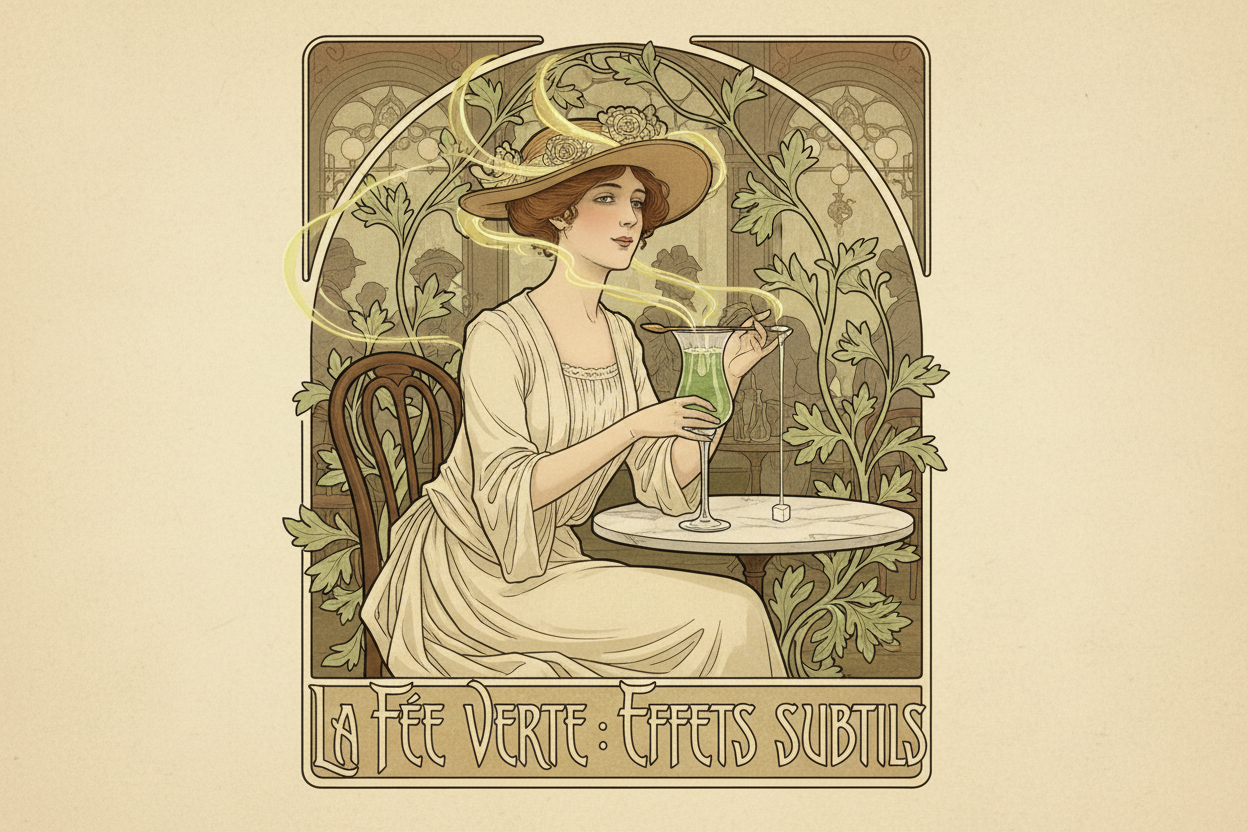
For centuries, it has been said that absinthe increases sexual desire. We examine this theory and uncover the truth behind the myth of the "Green Fairy."
Absinthe as an Aphrodisiac: Does Absinthe Really Increase Sexual Desire in Women?

Aphrodisiacs are substances used to increase libido and potency. There is disagreement about the effectiveness of these remedies. This also applies to the effect of absinthe on women. The online magazine WELT titled one of its articles on the history of absinthe: "This drink makes women willing, men weak."
Lovers of the "Green Fairy," as absinthe has also been called for centuries, are familiar with statements like those in the WELT article and occasionally pass them on. In doing so, people themselves keep alive the myth of absinthe's libido-enhancing effect from generation to generation. The question arises: Is there any truth to the centuries-old claims about absinthe's effect on women? A look at the ingredients of the spirit should provide clarity.
Absinthe contains two ingredients that are relevant in terms of a potentially aphrodisiac effect on women. One ingredient is alcohol, but this is contained in every alcoholic beverage and does not make absinthe special at first glance. Note: At first glance! More information later about the role alcohol plays here. For now, let's turn to the ingredient thujone – is this perhaps the key to thrilling erotic nights thanks to absinthe's effect on women?
Thujone: A neurotoxin whose maximum content in alcoholic beverages is regulated
Absinthe contains the neurotoxin thujone, which is derived from wormwood oil. Wormwood oil, in turn, comes from the wormwood plant, which is used as an ingredient in the production of absinthe. So, does wormwood cause the effect of absinthe on women? A distinction is generally made between the more active α-thujone and the less active β-thujone, with α-thujone being the psychotropic active ingredient. "Psychotropic" means that α-thujone affects the psyche. Both α-thujone and β-thujone are found in absinthe.
But be careful! Anyone who now believes that the psychotropic effect of α-thujone contained in absinthe would also prove the potentially libido-enhancing effect of absinthe on women is on the wrong track. There is a legal limit of 35 mg/l for thujone in alcoholic beverages for absinthes traded in Germany. Up to this limit, the thujone in absinthe has no effect – at least according to the current state of science.
Exceeding the limit of 35 mg/l thujone in absinthes would be a breach of law and is therefore highly unlikely. Even more interesting is a look at absinthes from the last century, because researchers have not found higher thujone levels than 25 mg/l in absinthes from that century. Is the entire myth of the aphrodisiac effect of absinthe on women thus refuted? We take a closer look at the psychotropic effect of thujone in search of an answer.
Does psychotropic thujone cause the alleged absinthe effect on women?
Let's assume that in the two to three centuries during which the effect of absinthe on women was observed, there were also drinks with a thujone content higher than 35 mg/l and that people drank this absinthe with the strongest effect.
Additionally, let's assume that people two centuries ago consumed several liters of absinthe per week, so that despite the low thujone content per liter, they ingested an effective dose of thujone.
Under these two assumptions, it is at least worthwhile to consider the potentially psychotropic effect of thujone as a possible explanation for absinthe's effect on women. Spektrum.de, in its Neuroscience Encyclopedia, describes thujone as the cause of the poisoning symptoms caused by absinthe, which are summarized under the umbrella term "Absinthism." In Spektrum.de's encyclopedia entry on absinthism, its consequences read as follows:
- Increased well-being
- Visual and auditory hallucinations
- Deep depressions
- Epilepsy-like seizures
- Severe metabolic disorders
- Liver damage
There is even talk of complete physical and mental decay. But wait: Are we really still talking about an absinthe effect on women here, or about a different clinical picture?
What is striking about the symptoms of absinthism is that they resemble or are even identical to the side effects of excessive and frequent alcohol consumption. This is also how the majority of scientists today view it, denying absinthe its psychoactive effect. They suspect that the always highly concentrated alcohol made absinthe so effective. Thus, absinthism was probably nothing more than alcoholism that society at the time did not recognize as such. But what does that mean for absinthe's effect on women?
Ultimately, thujone may be a psychotropic/psychoactive substance, but there is no indication that thujone was ever responsible for a special effect of absinthe on women or on humans in general. Instead, a legitimate suspicion arises, which we want to pursue in search of the actual effect of absinthe: Did people 200 to 300 years ago perhaps succumb to uninhibited intoxication, and was the high alcohol content of absinthe possibly responsible for its strong effect?
The usual suspect: Is alcohol to blame for absinthe's special effect on women?

True absinthe, as it originated, has an alcohol content of approx. 70%, like our Hills Absinthe 70% vol. 0.7l. Absinthe with the strongest effect can even have an alcohol content of 90%, but this applies only to a small proportion of products. In any case, it is clear: absinthe exceeds the alcohol content of various other spirits, and so absinthe may have a particularly strong effect on women.
Thus we have found the peculiarity of absinthe: alcohol, a substance that unites all spirits, is present in absinthe in a particularly high concentration. With all the myths about wormwood, sage and other herbs, and - later in science - with all the debates about the psychotropic effect of thujone, it was apparently always alcohol that was responsible for the intense effect of absinthe on women.
Whoever drinks a glass of absinthe instead of a glass of whisky has approximately one and a half times the amount of alcohol in their system. But even more: If one traces the origins of absinthe back to France at the end of the 18th century, it becomes clear that absinthe, alongside wine, was the only alcoholic beverage that found widespread appeal across all social classes – from poor to rich, from chic to coarse.
From an average of 12 to 14.5% red wine to approx. 70% absinthe, it was an enormous leap in alcohol consumption for the French, who primarily consumed wine. In addition to the usual quantities of red wine, they also consumed absinthe, which led to irresponsible alcohol consumption across large segments of society. This was even promoted by the advertising machinery, which heavily beat the drum for the trendy drink and even presented it as a miracle cure.
Furthermore, in France, absinthe was considered a luxury item, for the consumption of which even a lady of fine society did not have to be ashamed. Now the question of our article almost answers itself: Is there a special effect of absinthe on women? Yes, because absinthe generally has a significantly higher alcohol content than other spirits, and alcohol in general has a strong effect on the female organism. However, it undoubtedly also had a noticeable effect on the opposite sex.
Not thujone, but alcohol is the solution to the riddle. The usual suspect, then.
Stronger effect of alcohol on women

There are certainly women who can tolerate more alcohol than men. However, this is not the rule, as numerous sources, such as the Federal Centre for Health Education (BZgA), report and explain. They point out that women have a lower proportion of body fluid, which means more alcohol enters the bloodstream.
If the average woman and the average man each consume two glasses of absinthe, the absinthe will affect women more strongly than men, as there is a higher alcohol content in the blood. Furthermore, women generally have less body mass than men, so the alcohol is distributed over a smaller body mass and has a stronger effect than on men. Another important point in comparing the effect of absinthe on women and men: The proportion of enzymes responsible for breaking down alcohol is lower in women.
With this information in mind and the knowledge of absinthe's high alcohol content, it is understandable how the stories about absinthe's libido-enhancing effect on women could have arisen: Women reacted more strongly to alcohol than men, which can be understood based on their physical and physiological constitution. The apparently particularly high consumption of absinthe in 19th-century France probably intensified the difference between the effect of absinthe on women and men, presumably contributing to the emergence of a myth about absinthe's aphrodisiac effect. Since alcohol can have a disinhibiting, relaxing, and euphoric effect, it is conceivable that the impression actually arose that absinthe had a libido-enhancing effect. However, in today's enlightened society, this statement is not tenable.
It is clear that absinthe affects women, but just as much so men. This effect is exclusively due to the extraordinarily high alcohol content. Accordingly, a smaller proportion of women are very likely to reach for absinthe today than in 19th-century France.
Thus, there is fundamentally no special effect of absinthe on women, as long as they do not drink too much. However, this conclusion also applies to men and also to other types of spirits besides absinthe. This finding slightly demystifies the saga of the "Green Fairy," but it by no means robs it of its proud history of the last centuries. And not of its unmistakable taste, which regularly enchants spirit lovers, especially in Europe, and entices them to taste the emerald green drink. They no longer have to worry about the thujone contained or the effect of absinthe on women.
FAQ – Questions and Answers
Does absinthe have an aphrodisiac effect on women? +
This myth persists, but it is not scientifically proven. The effect of absinthe is primarily due to its high alcohol content. Differences between women and men are mainly due to metabolism and alcohol tolerance.
Is absinthe dangerous to health? +
As with all high-proof spirits, the risk is primarily related to the amount consumed. Absinthe usually has over 60% alcohol, which is why it should be enjoyed responsibly. In the compositions approved in the EU, however, it is no more dangerous than other comparable spirits.
Can absinthe cause hallucinations? +
It was formerly believed that thujone, contained in wormwood, could induce hallucinations. However, in the legally permitted amounts today, thujone has no hallucinogenic effect. The supposed effects are rather due to the high alcohol content.
Why is absinthe called "Green Fairy"? +
The name originated in the 19th century. Artists and writers described absinthe as an inspiring muse and associated it with creativity and passion. This poetic depiction led to the term "Green Fairy."
How much absinthe is safe? +
There is no exact "safe" amount – that depends on body weight, drinking habits, and individual tolerance. Generally: absinthe should be consumed in small quantities and with caution. Traditionally, it is diluted with water to soften the aroma and drinking strength.
Where can one buy reputable absinthe? +
Transparency regarding alcohol and thujone content as well as clear indications of origin are important. Those who want to discover absinthe will find a selection at delicando that includes both classic and modern interpretations.