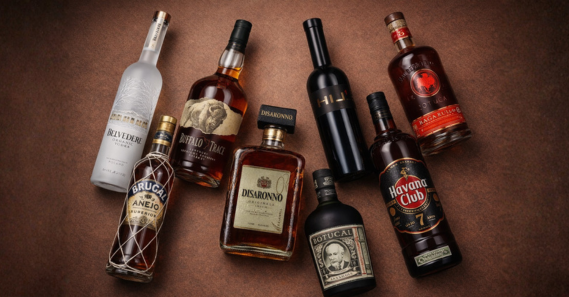
Rum or not rum or just a little bit – what is it then?
Typical Cachaça Characteristics
- Distillation from sugarcane juice or sugarcane syrup
- usually elaborately double-distilled with the addition of fermentation accelerators such as flour, corn starch, or bran
- extra added sugar: 30 g per liter after distillation
- Alcohol content between 38% and 48%
- Produced exclusively in Brazil
Typical Rum Characteristics
- Distillation from molasses
- does not require a fermentation accelerator
- Minimum alcohol content of 37.5%, no upper limit
- without further sugar addition
- Specific production location not mandatory
The production of rum allows for several processing options, whereas Cachaça production does not. The latter must be based exclusively on freshly extracted sugarcane juice. Rum, mostly produced from molasses, however, can alternatively be made from sugarcane syrup or fresh sugarcane juice. It would be wrong, though, to equate rum made from fresh sugarcane juice with Cachaça. Rather, this is a so-called Rhum agricole, an additional rum category. What also characterizes this Rhum agricole: it may only be produced in France or one of its overseas departments.
As a reminder: In addition to the respective raw materials fresh sugarcane juice, sugarcane syrup, and molasses, other characteristics define the differences – for example, alcohol content and place of production. Thus, Cachaça could at best be described as a Brazilian rum variety. But would that do it justice? "Firewater," as the term Cachaça translates to in German, is not just one subcategory among many rums. In reality, Cachaça holds a very special status: it is Brazil's national drink par excellence.
What exactly is molasses?
It's easy to picture sugarcane juice and sugarcane syrup. With molasses, however, it's difficult unless one has already delved into the subject. In short, molasses is a constantly accumulating byproduct of raw sugar production. This origin explains why molasses gives rum varieties a more or less pronounced sweet caramel aroma. Spirits based on sugarcane juice and sugarcane syrup, on the other hand, tend to be drier, meaning less sweet, but fruitier or spicier. Although molasses is not a direct product of sugarcane, but an industrial byproduct of sugar production, molasses is by no means inferior. It's simply different. Ultimately, personal taste determines what one likes. And good rum is surely beyond any doubt regarding its quality. But back to the Brazilian national drink.
How is Cachaça made from sugarcane juice?
The basic ingredient for the famous Brazilian schnapps is pure sugarcane. This means that after harvesting, all green parts are cut off. Then, special rollers thoroughly press the sugarcane. The sugarcane juice that emerges is collected in a stainless steel fermentation tank. During the subsequent fermentation, the addition of yeast is unnecessary, as yeast fungi naturally reside on sugarcane. These are practically obsessed with sugar – a win-win situation for both sides: the fungi and the sugarcane juice. The fermentation process is also strongly supported by the tropical climate: it takes less than 24 hours. Even at this stage, the alcohol content of the sugarcane juice is between 15% and 18%.

Now it's off to the still for what is usually a double distillation. A mild taste is almost always desired. The frequency of distillation is responsible for this: therefore, preferably twice rather than just once. After this processing step, the distillate has an alcohol content ranging from 38% to 48%. If the upper limit of 48% is exceeded – no problem: the manufacturer simply dilutes the spirit to the permissible drinking strength with the appropriate addition of pure water. From here, the Cachaça is ready for sale. It reaches stores as an original, affordable variant. After the obligation, the freestyle is still open in production: higher-quality Cachaças, for a correspondingly higher price, undergo additional developmental production stages. Comparable to fine wines and also rum, they mature for months or even years in wooden barrels. While rum almost always rests in oak barrels, Cachaça can be stored in barrels of many different types of wood. It is rumored that there are currently 22 varieties, including tropical hardwoods. Each wood gives a little of its natural color and individual aroma to its alcoholic content.
Cachaça production in Brazil often still takes place traditionally in countless small distilleries. There are said to be approximately 30,000 small businesses, primarily located in the regions of Rio de Janeiro, Alagoas, Pernambuco, Bahia, and Minas Gerais. The products of such artisanal manufacturers remain almost entirely within Brazil. The well-known Cachaça brands of larger producers, such as Canario, Velho Barreiro, Nêga Fulô, Ypióca, and – last but not least – Cachaça Pitú, make their way to the EU and largely to Germany.
What's special about Cachaça Pitú?
What's the deal with the Cachaça variant Pitú, which calls for attention on the shelf with its red-and-black label and iconic shrimp, and gets it? Contrary to common belief, Pitú does not originate from an exceptional production method and is not an exclusive premium Cachaça. Pitú is "merely" a Cachaça brand – nothing more. Nevertheless, opinions on Pitú are occasionally divided. The reason: Pitú never comes from traditional production methods of small businesses with copper stills but is exclusively produced industrially as a mass product. Drunk neat, Pitú impresses with a strong, sweet, and burning taste impression that some love, while others find it almost aggressive. So, whether Pitú is liked is primarily a matter of taste. However, this also applies to all other Cachaças.
Despite mass production, Pitú has retained its soul. Indeed, this Cachaça brand is more than just a cleverly marketed spirit. The Brazilian schnapps with the shrimp emblem comes with its own story. Its origin lies in northeastern Brazil, where it was created in 1938 by two gentlemen named Cândido Carneiro and Ferrer de Morais. The schnapps was named Pitú after the freshwater shrimp of the same name, which abounds in several Brazilian rivers, including near the company's current main factory. In the 1980s, the shrimp Cachaça made it to Germany, where it held a unique Cachaça status in many regions for a long time.
Cachaça Drinking Pleasure: Rarely Solo
No matter the Cachaça variety: it is rarely drunk neat – neither in its country of origin, Brazil, nor in Europe. This distinguishes it from the many rum varieties, which are appreciated both on their own and as an ingredient in hot drinks, long drinks, or cocktails.
Two Cachaça cocktail recipes are world-famous: Caipirinha and Batida de Coco. In principle, the Brazilian sugarcane spirit is suitable for numerous other alcoholic creations. A unit of Cachaça can often replace a comparable ingredient in another cocktail recipe, for example, white rum or vodka. Of course, this changes the taste of the drink, which means variety or even a taste advantage. Cachaça experiments are worthwhile – just be brave and get started!
Although so popular as drinks, many do not know their recipe: Caipirinha and Batida de Coco. Reaching for the bottle with the ready-made mix is convenient but also arbitrary. However, mixing your own Caipirinha is wonderfully uncomplicated here. And a store-bought bottle of Batida de Coco can be spiced up into an individual delicacy with just a few simple steps. The recipes are per glass:
Caipirinha Recipe
The popular Brazilian cocktail requires only four ingredients. Here's the recipe for one glass of Caipirinha:

Ingredients:
- 1 lime
- 2 teaspoons cane sugar
- 6 cl Cachaça
- Ice cubes
Here's how:
Wash the lime thoroughly with lukewarm water and quarter it. Place it in a glass and sprinkle the cane sugar over it. Now squeeze the juice from one of the lime quarters into the glass, discard the squeezed peel, pour the Cachaça into the lime juice and the remaining three lime quarters, and mix everything well. Finally, add the ice cubes and enjoy the refreshment.
Tip for a Caipirinha variation: If you've tried one Caipirinha, do you know how all the others taste? No way! Who spread that rumor? He or she should only be served the nastiest Caipirinha imitations made from the cheapest swill from now on, as their taste buds are apparently hopelessly rotten or – now it's getting really bad! – a malicious character is behind such a claim. Of course, there's a basic recipe for Caipirinha: After all, certain consumer expectations are associated with this cult drink. Nevertheless, it's not forbidden to tweak a Caipirinha recipe a bit. The quantities of ingredients also vary, and the basic ingredients are not 100% identical either. A Caipirinha is a Caipirinha... but each in its own way. There!
If you want to stand out from the sea of Caipirinha offerings, you have one more attempt: the Caipirinha Pitú. The special designation already hints at the unique taste experience. The distinctive taste characteristics of Pitú mentioned above give this Caipirinha its special touch. Preparation is as in the recipe above, only a Pitú replaces the conventional Cachaça spirit. Saúde!
Batida de Coco Recipe
The trendy Brazilian long drink Batida de Coco also requires only four ingredients:

Ingredients:
- 3 cl Cachaça
- 2 cl Batida de Coco
- 8 cl coconut milk
- crushed ice (as desired)
Preparation:
Pour the liquid ingredients into a long drink glass holding at least 15 cl and stir thoroughly. Add the crushed ice and enjoy. Optionally, the drink can be garnished with a few coconut flakes or coconut chips.
Become a Cachaça Specialist
Although popular in Germany, cachaça is primarily known as an ingredient for caipirinha. Product quality seems almost secondary. However, it is worthwhile to try different brands and discover your personal favorites. Why not become a cachaça connoisseur, similar to the highly regarded wine connoisseur, and inspire others with the Brazilian national drink? Whether neat, as a cocktail, in a long drink, or even as a sophisticated ingredient in fine dishes: a cachaça specialist impresses with exceptional knowledge and leaves a positive impression.