Anyone exploring the history of cocktails inevitably encounters the question of the term "cocktail's" origin, which this article addresses.
Where does the term "cocktail" come from?
Those who regularly follow our blog will have noticed that we not only love spirits but also have a great affection for language – for example, we've extensively discussed tasting notes, consistently celebrated successful brand names, and delved into the origins of specific terms, which we will do again within the context of our cocktail history.
But can the first use of the term "cocktail" and thus its "inventor" even be definitively identified? We shall see. But before we attempt to solve the riddle, let's take an introductory look at the dark ages when the term "cocktail" did not yet exist.

Cocktails before there were cocktails
The history of cocktails – that is, the history of mixing alcoholic beverages with non-alcoholic ingredients – actually begins long before the term itself was coined.
In this context, reference is usually made to the 17th century – when people in England began mixing and drinking so-called "purls": ale with vermouth, which was believed to have health benefits. Already in the 18th century, especially in the London region, it was common to mix alcoholic beverages with other spirits, but also with sugar, water, and ginger – thus essentially inventing the "proto-cocktail," which only later became popular in the USA. Contrary to popular belief, the origin of the cocktail is therefore not in the United States.
At this point, we also want to mention that ginger, in particular, was a central ingredient of "proto-cocktails," which should be kept in mind, as this healthy, but also spicy root will play another (albeit unsavory!) important role later in cocktail history.
In short, two main reasons for the production of such purls can be identified:
Supposed and actual health benefits: The idea that alcohol, consumed in moderation, could indeed be beneficial to health, was already known in past centuries. This was especially true when it was mixed with health-promoting ingredients, such as the aforementioned ginger.
A very obvious benefit of adding alcohol also concerned the often questionable drinking water of earlier times, which could be effectively disinfected by high-proof additives.
Improvement of taste: Beyond health considerations, in earlier times, people were driven by sheer desperation alone to resort to palatable ingredients to mask the pure, barely tolerable fusel taste of the then still quite inferior alcohol.
The various theories about the name "Cocktail"
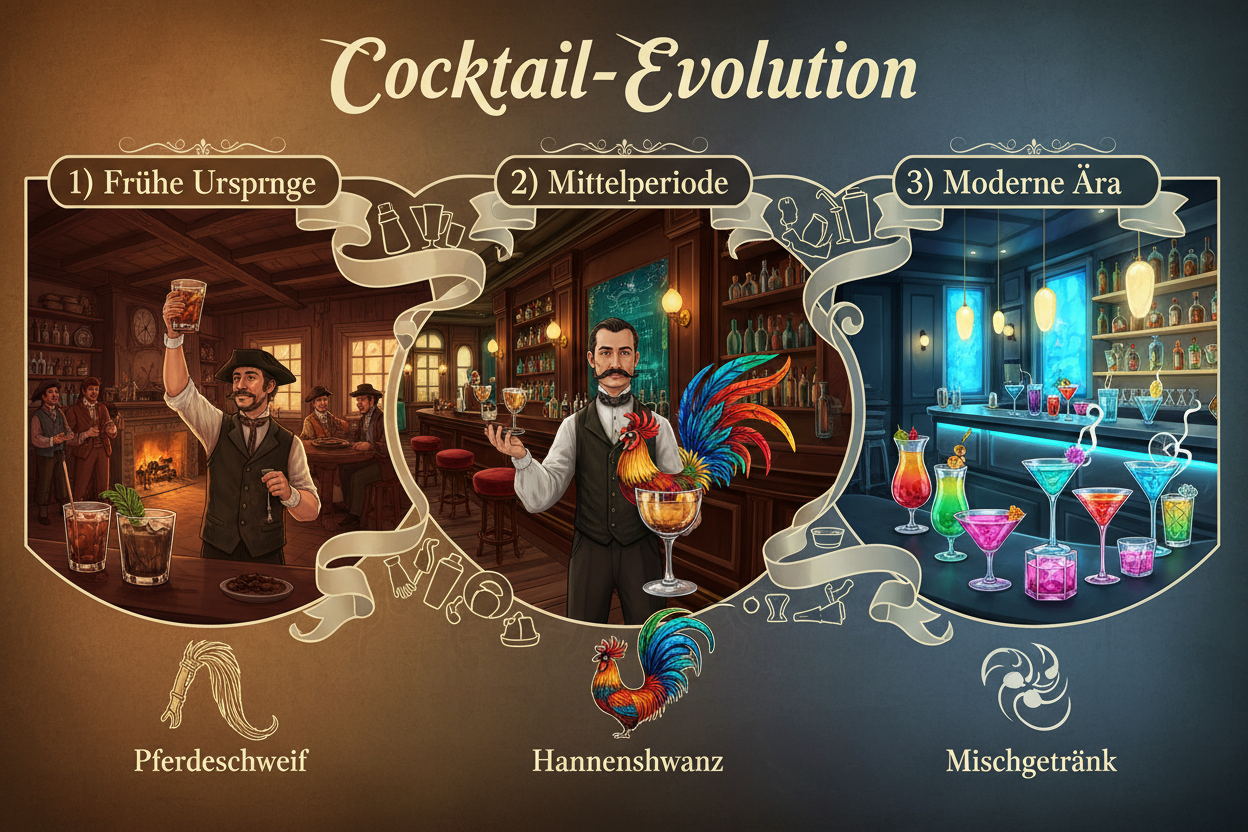
For most people whose mother tongue is not English, the term "cocktail" is initially nothing more than a mere name that means nothing to them. To native English speakers, however, the word is not "a closed book," but the English equivalent of "rooster's tail" – in the English-speaking world, you spend a pleasant evening in a "rooster's tail bar" and admiringly watch the bartender conjure "rooster's tails" into a glass.
How, pray tell, did this name – which, it is assumed, came about in the 18th century – originate, which at first glance (and also at second!) has nothing to do with an alcoholic mixed drink? Unfortunately, there is no conclusive answer to this question; however, several possible explanations are in circulation, which we would like to briefly present.
First, there are some suggestions that consistently assume an actual connection with the aforementioned fowl, albeit with different details. In the cockfights that were still very popular in the 18th century, it became customary for the owner of the winning rooster to be entitled to the "cocktail" (i.e., the feathers of the opponent killed in the fight) and to celebrate the victory with a drink (and the toast "Let's have a drink on this cock's tail"), with the victory drink itself soon also being called a "cocktail."
Likewise, the interpretation circulates that the drinks were decorated with rooster feathers, which is why the name described an actual aspect of the drinks. Another speculation sees the naming motivated by the fact that mixed drinks with different colored liqueurs that do not mix in the glass resemble the colorful appearance of a rooster's tail when viewed from the side.
A completely different solution proposal is in the linguistic field: To continue serving high-proof alcohol during Prohibition, a French apothecary in New Orleans is said to have come up with the idea of serving his drinks innocuously in egg cups. If you can't see a connection to the term "cocktail" here, consider the French word for "egg cup": This is (exactly!) "Coquetier," from which the corruption "Cocktail" could have very quickly developed in the multilingual melting pot of multicultural New Orleans.
Occasionally, the "horsetail theory," to which we alluded in the heading, is also represented. Here it gets a bit more complicated, but with a surprising twist.
If we venture into the field of horse breeding or horse trading, we find that the term "cocktail" also existed there in the past: It referred to horses that were not purebred and whose tails were docked as a widely visible indication of their genetic "deficiency." As a result, the animals carried their remaining tails higher – in the manner (exactly!) of a rooster's tail.
But how do we get from this animal cruelty to our alcoholic mixed drinks?
Here, ginger comes into play again: In the horse markets of the time, horse traders (thus proving to be the proverbial "horse copers"!) used ginger, among other things, to literally "light a fire under the behind" of "cocktail horses" which lacked a bit of temperament due to their lack of "breed," in order to positively influence their sales chances – they actually pushed gut-irritating ginger into the poor quadrupeds' hindquarters! Thus we have the chain of association that is supposed to lead from the cocktail horses, via the crucial ingredient ginger from the proto-cocktails, to the definitive name for our mixed drinks.
Which of these speculations do you find most likely? Or do you know of any other conjectures about the origin of the term "cocktail"? Then please write to us, perhaps you know the solution to the riddle!
A brief history of the cocktail
Now that we have established that nothing can be definitively clarified regarding the origin of the name, we want to follow up with a brief history of the cocktail up to the present day.
While England and Scotland are considered the origin, the concept of the cocktail achieved global recognition in the USA. While whiskey was always diluted with water in the States, cocktails (also under this name) became increasingly popular in the modern sense during the 19th century. Another heyday of alcoholic mixed drinks, when cocktails made history, was ironically the years of Prohibition in the USA. After the Second World War, the cocktail finally began its triumphant march around the world.
So much for a very brief cocktail history, which we will certainly discuss in more detail another time. Let's turn now to a delicious cocktail and be glad that from the dark age of animal cruelty with gruesome cockfights and sadistic horse-trading methods, only the name of the mixed drinks we all love has remained!
FAQ – Origin and History of the Cocktail
Where does the term "cocktail" come from? +
The exact historical origin of the term "cocktail" cannot be clearly proven. It probably emerged in the 18th century and is still interpreted differently today. It is only certain that the name was established after the practice of mixing drinks.
Did cocktails exist before the actual cocktail era? +
Yes. Already in the 17th and 18th centuries, alcoholic beverages were mixed with ingredients such as sugar, water, ginger, or vermouth. These so-called "proto-cocktails" served both health purposes and to improve the taste of inferior spirits.
What theories exist about the origin of the cocktail's name? +
Among the best-known explanations are the reference to cockfights, decorative rooster feathers in a glass, color-layered drinks, and a linguistic derivation from the French word "Coquetier." However, none of these theories are considered definitively proven.
What role did ginger play in early cocktail history? +
Ginger was a central ingredient in early mixed drinks and was valued for both its health-promoting and flavor-intensifying properties. In some origin theories, ginger also plays a symbolic role in the later naming of the cocktail.
Why is it worth exploring the history of cocktails? +
Exploring the history of cocktails shows how closely enjoyment, language, and culture are intertwined. For those who want to delve deeper into classic recipes, spirits, and their backgrounds, delicando offers not only products but also further content on the origin, style, and development of cocktails.