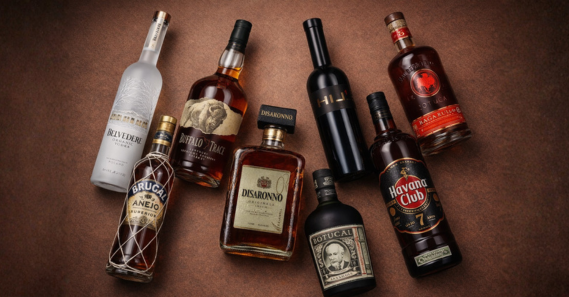
Having already introduced a whole host of national drinks, today we turn our attention to the Netherlands: What distinguishes Genever from Gin?
What is Genever?
Genever (sometimes spelled "Jenever") is a juniper spirit produced according to a traditional recipe in the Netherlands and Belgium. In these countries, the cities of Schiedam (Netherlands) and Hasselt (Belgium) are particularly known as places of origin for this spirit, from which, as already mentioned, the now popular gin developed. The alcohol content is at least 35% vol., and only products from the Netherlands and Belgium, as well as from some smaller regions in Germany and France, are allowed to bear the name "Genever." Equally crucial, however, is the presence of juniper.
The name "Genever" refers to the plant central to this spirit: the Dutch "Jeneverbes" or French "Genévrier" stands for juniper, an evergreen, slow-growing shrub or tree belonging to the cypress family and found almost exclusively in the Northern Hemisphere. For about 3,500 years, the plant has been used in healing arts and as a spice, mainly due to the essential oils, terpenes, and flavonoids found in its needles and berries. Its medicinal and therapeutic uses are diverse, including treatment for digestive problems, as a diuretic, and externally in rheumatism and gout therapy. Current studies suggest that juniper may also have some anti-tumor effects.
History of Genever
The origin of Genever is not entirely clear; however, it can be reliably documented that a popular social drink of the same name already existed by the end of the 16th century. It is therefore more than questionable whether Genever, as some sources erroneously claim, was "invented" only in the 17th century by the Dutch physician and natural scientist Franciscus Sylvius, who in turn is said to have drawn on a medical juniper recipe from a monastery that originated centuries earlier.
We will go into more detail later, but essentially, Genever originated as a grain spirit, i.e., a kind of "unfinished" whisky, which was directly flavored with juniper. This was essentially a makeshift solution – because the mostly inferior and therefore barely drinkable schnapps had to be effectively "masked," for which aromatic juniper was an obvious choice.
During the Thirty Years' War, which brought soldiers from all over Europe into contact with each other in various coalitions, English soldiers in the Netherlands became acquainted with Genever and saw in this "magic potion" the reason for the proverbial courage of Dutch fighters. Subsequently, two things happened: The Dutch name was shortened to the easier-to-pronounce "Gin," while in England, a unique Genever variation was later created under this name and helped to achieve worldwide recognition.
This brings us to the point where we absolutely must address the difference between Gin and Genever. Let's first look at how Genever is made.

The Production of Genever
It may have surprised some readers, but Genever is, as already mentioned, essentially nothing more than a blend of completely different spirits. It starts with a distillate from barley or rye malt, to which corn or wheat is sometimes added in rare cases. And rightly so - the intermediate result is indeed nothing other than unaged whisky, which is called "malt wine" in the Netherlands. It is sometimes also pointed out that we are quasi dealing with a mash here, which is not dissimilar to beer.
In any case, juniper is used for subsequent flavoring, although caraway, anise, and coriander are sometimes also used.
What distinguishes Gin and Genever?
To avoid unnecessarily complicating the distinction, we will forgo a further historical account here and pragmatically limit ourselves to the decisive difference, which almost naturally emerges from what has already been said: while Genever is (originally) a grain spirit, a kind of "distilled beer" (to put it very loosely!), which is directly flavored with juniper (and a few other herbs), gin is a (grain-free!) distillate from neutral alcohol, mixed with juniper and a virtually infinite number of other herbs ("botanicals").
The fact that gin is a grain-free Genever is, of course, also noticeable in the taste: Genever typically has a "fuller" aroma, with the extra "malt wine" also responsible for additional grain aromas on the finish. Further differences lie in the areas of color and viscosity: on the palate, Genever is usually perceived as "smoother" when tasted. However, these differences are increasingly blurring, which leads us to our next topic: the types of Genever, of which we will introduce the three most important.
The three most important types of Genever
"Young Genever" encompasses all Genever classified as the "younger type," which essentially means they are blended with a lot of neutral alcohol. Legally, it is stipulated that they may contain a maximum of 15 percent malt wine and no more than 10 grams of sugar per liter. In the end, the taste is more reminiscent of Vodka than Dry Gin.

"Old Genever" primarily refers to any "classic Genever"; however, any Genever can be called "Oude" if it consists of at least 15 percent malt wine and contains no more than 20 grams of sugar per liter. You get a spirit that tastes closer to whisky than to vodka.
"Corn Wine Genever" finally refers to products that are more suitable for hardened connoisseurs, as the "50 + 1" rule applies here, meaning only a Genever containing at least 51 percent malt wine may be called such. Since aging in oak barrels is often added, it's not surprising that you have a whisky rather than an Old Genever before you.
At least we want to mention that in the Netherlands and Flanders, various Genever liqueurs have developed based on Genever. In the Netherlands, Bessenjenever, a red Genever traditionally enriched with blackcurrants, is also considered a true specialty.
Our Genever Recommendations
Finally, let's take a look at two Genevers that we'd like to recommend and which you can order in our shop.
Bols Genever Amsterdam Gin
The Bols family name is one of the most famous in the world of spirits, with the globally renowned company tracing its roots back to Lucas Bols of Amsterdam, who from 1575 produced various spirits in his distillery on the outskirts of the city using spices from all over the world – including the first Jenever. The company has thus mastered the art of distilling for over 400 years, still exclusively using high-quality natural ingredients such as herbs, spices, and fruits, processed according to time-honored recipes that nonetheless meet modern tastes.
This Genever is a whisky-like distillate, referred to as "malt wine" in the Netherlands, and is made from rye, corn, wheat, and, of course, juniper berries. The clear liquid imparts aromas of malty grain notes, sweet juniper, honeysuckle, and citrus fruits to the nose. As for the complex, fruity taste, juniper berries dominate alongside malt. The experience is rounded off by a long-lasting finish.

De Borgen OLD-STYLE GENEVER
In its fourth generation, the Hooghoudt Distillery, founded in 1888 and a traditional family business, produces its products, such as this Old-Style Genever, exclusively from pure natural ingredients. Among the many features that distinguish this Genever is a distillation process that dates back to traditions from the 17th and 18th centuries, resulting in a Genever with a strong malt character. The unique combination of a 17-year-old malt, juniper berries, grain distillate, and an unaged malt has aromas of wood and anise, rounded off by a hint of warm spice notes. In the soft taste, barley and the aforementioned warm spices blend with hints of juniper berries and oak aromas. To describe the long-lasting finish, our taster found the adjectives elegant, woody, and spicy to be apt.
"Proost, op onze gezondheid!"