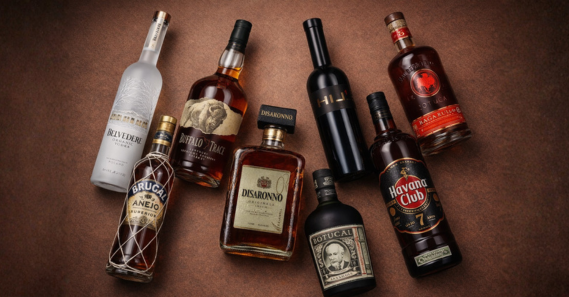
What is the difference between brandy and Cognac? We delve into the background of both terms and show you some delicious options to try.
Brandy

Brandy is a general term for spirits made by distilling fermented liquids. According to the Austrian Food Codex, a brandy (or "wine distillate") is a "product made exclusively from suitable wine using traditional distillation methods." The raw materials can be of many kinds – for example, fermented grapes, fermented fruit juices, sugar cane molasses, or barley, wheat, or rye malt.
There are various types of brandy from different regions all over the world. As mentioned, the ingredients vary, and the distillation and aging processes can differ from region to region. However, the rule is: if the spirit is produced by distilling a fruit wine, it is a brandy – no matter where it is produced.
Brandy can have an alcohol content of 30-60% by volume, but usually it is around 40% by volume. Brandies are sold bottled. It is common to enjoy brandy after a meal as a digestif or to serve it with dessert, cheese, or a cigar.
Brandy Naming Conventions
There are different ways to specify brandies. The label can simply state "Brandy" – but it could also include the brand name or the region.
Furthermore, the type of fruit used can be part of the name, which is often the case in the United Kingdom. There, the spirits are then called, for example, apple brandy or grape brandy.
Unlike in England, in German-speaking countries, brandy is usually simply called "Branntwein". However, there are also some brandies here that have cult status as a brand. This includes, for example, Asbach.
As mentioned, a brandy can also be named after a region. The three best-known regions that lend their names to various brandies are located in France – Armagnac, Calvados, and the region around Cognac.
You read that right: Cognac. Cognac is probably the most noble and perhaps most popular brandy. In the following, we will dedicate ourselves to this famous and delicious variety.
Cognac
Cognac, probably the noblest of brandies, is named after a small town in southwestern France, where the famous spirit has been produced for more than three hundred years from the region's unique grapes.

Cognac Naming and Production Rules
There are strict rules for the production of Cognac – the name is therefore much more protected and, of course, a much more specific designation than "brandy". One of the rules is that only very specific grape varieties are permitted for its production. Furthermore, Cognac is distilled not just once, but twice in impressive copper pot stills. The rules also state that Cognac must mature for at least two years in French oak barrels. If these conditions are not all met, then it is not Cognac.
Differences between Brandy and Cognac
It should be clear by now that there are some differences between brandy and Cognac. Generally, every Cognac is a brandy, but not every brandy is a Cognac. There are several reasons for this.
While the name "Cognac" is protected by strict production rules for the spirit, the term "brandy" can be used for any spirit distilled from fruit wine.
Furthermore, a brandy can fundamentally be produced in any region (or wine region) of the world, whereas Cognac exclusively originates from the area around the French town of Cognac.
Presenting: Cognac and other Brandies
Trying is better than studying – that's why we will now turn to a selection of spirits that are guaranteed to be worth tasting.
Camus VSOP Borderies Single Estate Cognac
The Camus VSOP Borderies Single Estate Cognac comes from the smallest of the six Cognac growing regions: the AOC Borderies. The traditional farmhouses of the Charente region have a stone wall, also called a "Border", bordering their square courtyards. The name Borderies originates from this wall.
The Ugni Blanc grapes from the Camus domain's vineyards, from which Cognac is often made, find their most beautiful expression in the VSOP. It is not surprising that this Cognac has received a number of awards. At the World Spirits Award in 2019, it won Gold, as it did at the World Spirits Competition in San Francisco in 2018, and at 'The Spirits Business – The Cognac Masters' competition in the same year. At the World Spirits Competition in San Francisco, the noble spirit even won Double Gold.

The Camus VSOP Borderies impresses with notes of vanilla pods, orange peel, and a floral spiciness that unfolds in the bouquet. This Cognac also boasts a vibrant orange-yellow color, with amber reflections for which Cognac is so famous. And its creamy, full-bodied finish is also seductive – a woody aroma and remarkable freshness go hand in hand.
Courvoisier VS
The Cognac house Courvoisier has existed as a company since 1828 and is today one of the four leading Cognac houses in the world. This house's Cognac was reputedly Emperor Napoleon's favorite, which is why it is also known as "Napoleon Cognac."
In Courvoisier Very Special, Cognacs aged for different lengths of time are blended, offering an exceptionally wide range of flavors. Courvoisier Very Special is a blend of various crus, aged between three and seven years. This Cognac consists mainly of Fins Bois and some Petite Champagne – truly delicious!
The Courvoisier VS also won an award, namely the silver medal at the World Spirits Competition in San Francisco in 2016. It is definitely worth a taste.

Its color resembles shimmering amber, its aroma is characterized by diversity: Fresh and fruity, the Courvoisier Very Special smells of oak and vanilla notes, as well as crème brûlée and candied orange. On the palate, this Cognac convinces with a harmonious, round richness, complemented by fruity notes and oak. It seems Napoleon indeed had good taste when it came to Cognac.
Asbach Original 3 Years
As mentioned, there are brandy brands that have cult status. And one of the most iconic is Asbach. There are good reasons for this, best explored in practice, but we want to offer you a foretaste.
The Asbach Original 3 Years is a spirit whose youngest component, as the name suggests, matures in oak for at least three years. With this example, the Rüdesheim winery has once again given a special expression to its tradition of high quality and excellence.
Its full-bodied, sweet notes of ripe grapes and fine oak guarantee an incomparable taste experience, while the eye can delight in its beautiful topaz color.
Here we are dealing with another traditional company whose history dates back more than 200 years. The Cardenal Mendoza is produced in the heart of the Spanish Sherry-producing region.
This brandy is of the highest quality – a fine Spanish brandy that can be perfectly enjoyed with coffee or a high-quality cigar. Even after a delicious meal, the Cardenal Mendoza is a pure delight. Who wouldn't immediately think of vacation and relaxation?
Metaxa 12 Stars
The Metaxa 12 Stars is a very special brandy. It is artfully crafted from valuable wine distillates that age for twelve years in oak barrels. These are exquisite Muscat wines, originating from the Aegean island of Samos, where the grapes are meticulously hand-picked. A bouquet of fine herbs completes the Metaxa 12 Stars into a Mediterranean delicacy.
The aromatic scent of this brandy is unforgettable. A combination of dried figs, orange peel, and the aforementioned herbs guarantees pure sensuality.
The Metaxa 12 Stars shines amber and is surrounded by copper-colored reflections. Its taste is skillfully diverse – this brandy seduces with a velvety, silky aroma that leaves nothing to be desired in terms of complexity. Its intense character is marked by notes of dark cocoa, honey-soaked figs and plums, and dried oranges. A hint of liquorice adds another twist to this artful composition.

If you feel like exploring the world of brandies even further, visit the delicando shop and make your search easy with our filters for Cognac and Brandy. The selection is vast, and browsing makes the anticipation even greater. Have fun!